Missed train connections in Italy
Two trains on one screen do not necessarily make one protected journey. Before booking a connection, check the contracts; if something goes wrong, ask for the right continuation before buying your own replacement.
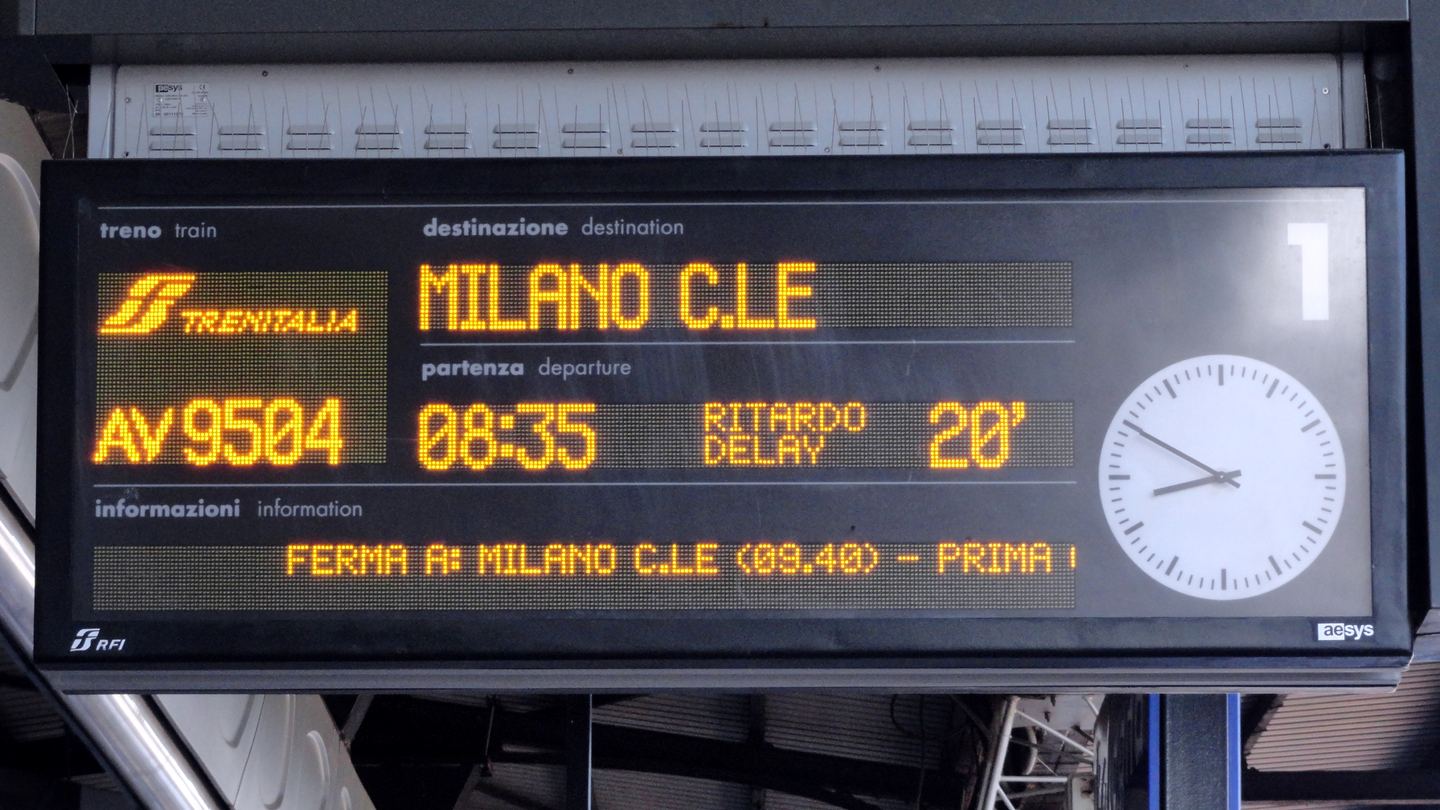
Bologna Centrale's departure board, photographed on September 22, 2012. This historical photograph illustrates disruption information, not today's departures or a protected connection. Caseyjonz, Public domain. Cropped for layout.

The short answer: not every connection has the same protection
If a delayed train makes you miss another train in Italy, the answer is not simply ‘buy again’ or ‘take any later service.’ First identify whether the journey is covered by a through-ticket or by separate transport contracts. Your Europe explains that through-ticket protection can include continuation or re-routing, or reimbursement, when the missed connection is expected to delay arrival at the final destination by at least 60 minutes. Individual tickets do not automatically carry that same missed-connection protection.
Read that as a checking framework, not a personal verdict. This dossier concerns disruption to a rail connection, not arriving late at the first station yourself. Keep the original booking, ask the operator what applies to the exact tickets, and distinguish the journey you want to finish from a claim you may make later. A replacement seat and money back are different questions.
SourceYour Europe, European Union1
- Your Europe, European Union · reopened October 9, 2026
Evidence note. Through-ticket status and expected final-arrival delay govern the missed-connection framework. This dossier does not determine a particular passenger's entitlement.
One payment is a clue, not the whole contract
A checkout can present several services together while issuing separate contracts. Do not infer the legal scope from one confirmation email, one total price or two adjacent train names. Before paying, ask: ‘Is the entire rail journey sold as a through-ticket? If not, where does each contract end, and what is the rule if the first train delays the second?’ Save the answer and the pre-purchase disclosure, not just the QR codes.
The EU's passenger FAQ describes circumstances in which a ticket vendor can be liable for a missed connection in a single booking, while also explaining the significance of advance information about separate transport contracts. That is why ‘separate tickets mean no rights at all’ is too broad. Rights concerning an individual service, the seller's conduct and voluntary continuation arrangements may be separate questions. Have the actual sale reviewed rather than using this article as a refund calculator.
SourceYour Europe, European Union1
- Your Europe, European Union · page checked September 15, 2026; reopened October 9, 2026
Evidence note. The FAQ distinguishes vendor liability from disclosure of separate contracts. No payment amount or personal claim is calculated here.
A regional train plus Italo needs an explicit check
Italo's current FAQ gives a concrete example: an Italo high-speed ticket and a Trenitalia regional ticket can form a connecting journey with separate tickets. In that arrangement, changes and refunds follow the relevant operator's ticket conditions. The FAQ directs travelers at risk of losing the next leg to contact that leg's operator promptly; an alternative connection is not guaranteed.
For your planning notes, record the operator, ticket type, change conditions and latest permitted change time for each leg. If delay starts developing, reopen those records while there is still a decision to make. Do not assume a cheap, fixed-departure fare behaves like a flexible one, or that another operator's train becomes available merely because you hold an unused ticket. This is an example from a published FAQ, not a claim that every multi-operator purchase has identical terms.
SourceItalo1
- Italo · reopened October 9, 2026
Evidence note. The separate-ticket sections describe the Italo high-speed/Trenitalia regional example. Fare rules and the actual sale remain decisive.
When the connection fails, ask for continuation first
Take the booking and delay information to the operator's official assistance channel or station staff. Ask which onward service you may use, whether a reservation or ticket endorsement is needed, and how to obtain evidence of the disruption. Our practical sequence is: establish the contract, establish the delay, obtain the onward instruction, then decide whether to continue or abandon the journey. This is an editorial sequence, not a new legal condition.
Trenitalia's passenger-rights information addresses missed connections within a cumulative ticket and sets out reimbursement or continuation/re-routing options in the listed disruption circumstances. An invitation to continue is not permission to select any premium train or class yourself. Keep the proposed solution and any authorization; if the next departure has reserved seating, establish the boarding arrangement rather than treating the old ticket as a new seat reservation.
SourceTrenitalia1
- Trenitalia · reopened October 9, 2026
Evidence note. Read the sections on disruption rights and substitute transport for the actual ticket. The operator's instruction is not an assurance of a chosen train or class.
The 100-minute rule is not a blank check for a taxi
The Commission's rail-rights Q&A explains a conditional self-re-routing route: when continuation options have not been offered within 100 minutes of the scheduled departure of the delayed or canceled service, or the missed connection, alternative public rail, coach or bus transport can be arranged without the carrier's consent. Reimbursable costs must be necessary, appropriate and reasonable. Before that point, the Q&A describes seeking the carrier's consent for your own alternative arrangement.
Do not turn this into ‘wait 100 minutes and charge anything.’ It does not automatically cover a taxi, rental car, flight or expensive hotel of your choice. Establish whether the rule applies to your contract and disruption, which departure starts the clock, and whether the operator has already offered a solution. Save timed messages and itemized receipts. The Commission labels its Q&A explanatory information; it is not an individual authorization or a guarantee that every expense will be accepted.
SourceEuropean Commission, Directorate-General for Mobility and Transport1
- European Commission, Directorate-General for Mobility and Transport · June 7, 2023; reopened October 9, 2026
Evidence note. Question 3 distinguishes consent-based alternatives from public rail/coach/bus self-re-routing after the stated window. Its disclaimer is explicit.
International continuation agreements are a separate route
For an international rail journey, check whether a voluntary arrangement applies. Trenitalia participates in the Agreement on Journey Continuation, or AJC. Its published guidance describes eligible international journeys involving participating companies, an adequate original connection time, the original ticket and proof of the previous train's delay or cancellation. Continuation stays with the carrier of the unused service; reserved-seat trains remain subject to availability in the purchased class.
AJC is not the same thing as a through-ticket, and it is not a universal rescue arrangement for every domestic combination. Trenitalia expressly distinguishes the voluntary agreement from statutory assistance, reimbursement and delay-compensation rights under each transport contract. When crossing into Italy from another country, keep this question beside the contract question: ‘Does a continuation agreement cover these carriers and this journey?’ Do not substitute a list of participating brands for checking the conditions of the actual trip.
SourceTrenitalia1
- Trenitalia · reopened October 9, 2026
Evidence note. The operator describes international scope, adequate transfer time, evidence and seat-availability conditions; AJC is voluntary, not a universal domestic entitlement.
Refund, compensation and assistance are different requests
Reimbursement addresses a ticket or journey you abandon under the applicable conditions. Delay compensation concerns late arrival and its qualifying rules. Assistance concerns what happens while you are stranded. Treating all three as ‘my refund’ can obscure what you actually need: an onward reservation now, an overnight solution, or a later payment claim.
Italo's passenger-rights summary separately describes continuation or reimbursement options, arrival-delay compensation, assistance and certification on request. It also identifies circumstances in which compensation is not due. Do not assume a delay automatically reimburses every purchase on the itinerary, or that choosing a refund leaves the same ticket available for onward travel. Preserve the option you selected and ask the responsible operator which request matches it. This dossier does not calculate an award, assess fault or decide which exception applies.
SourceItalo1
- Italo · reopened October 9, 2026
Evidence note. Italo separates journey options, delay compensation, assistance and disruption certification. Its summary is not a personal eligibility decision.
Three hypothetical journeys, three questions to settle
These are invented planning scenarios, not reported incidents or verified bookings. First: two rail legs sold as a confirmed through-ticket. The question is how the disruption affects arrival at the destination covered by that contract. Second: a regional ticket and a separate high-speed ticket. The question is what each fare permits, whether the sale carries additional protection, and which operator can change the next leg. Third: an international arrival followed by another company's train. The question adds any applicable voluntary continuation agreement.
Now add an independently booked flight or ferry after any of those trains. Do not assume a rail ticket protects that later purchase. Keep its deadline, terms and fallback in a separate planning note. The Commission identifies the applicable rail-rights framework but also flags possible service exemptions. Our conclusion is a planning one: map the contracts and obligations before optimizing the itinerary for the shortest-looking connection. A comfortable timetable and a legally protected journey are not interchangeable.
SourceEuropean Commission1
- European Commission · reopened October 9, 2026
Evidence note. The Commission identifies Regulation 2021/782 and possible service exemptions. The three scenarios and contract-mapping method are original editorial examples, not legal judgments.
Keep a record; use the right complaint route
Our suggested evidence file contains the tickets, checkout disclosure, planned services, disruption proof, the onward instructions, actual arrival and any receipts. Keep it privately; do not publish passenger names or booking codes in a social post. If a claim is refused, preserve both the request and the reason given rather than trying to reconstruct them from memory.
Italy's Transport Regulation Authority, ART, tells passengers to complain to the transport company first. Its SiTe page describes escalation after an unsatisfactory answer or no answer, with a 30-day no-response threshold for rail complaints. This supervisory route concerns possible passenger-rights violations; it is not a promise that the authority will pay you. Use the current ART instructions and relevant operator procedure for the specific case. We have not filed a complaint, assessed evidence or obtained a reimbursement for a reader.
SourceAutorità di regolazione dei trasporti1
- Autorità di regolazione dei trasporti · reopened October 9, 2026
Evidence note. Company-first complaint sequence and the stated rail no-response period. Escalation requirements must be checked on the current authority page.
Before you buy: the connection card
Make a short note for each connection before paying. The point is not to predict every delay; it is to know who can help and what you bought. Start with these four fields, then check the operator's actual sale and fare terms. This card is Italy, Sourced's editorial tool, not a carrier-approved form or a promise of protection.
- 01 / CONTRACT
Name the protection
Through-ticket, separate contracts or unclear: save the seller's disclosure and resolve unclear wording before payment.
- 02 / NEXT LEG
Know who can change it
Record the next operator, fare, permitted change window and official assistance route. Do not assume a replacement seat.
- 03 / CONSEQUENCE
Read the onward commitment
Identify the last onward service and any separately booked flight, ferry or timed visit. Choose your buffer from those consequences; no universal number is guaranteed here.
- 04 / EVIDENCE
Keep the actual records
Save tickets, contract disclosure and instructions. If disrupted, add delay proof, offered alternatives and itemized receipts before submitting the appropriate request.
On the trip-planning page, a journey like this is decision 3 of 6, each transfer: the exact station, airport or harbor, the operator, the timetable date, luggage, the last leg and a fallback.
SourceItalo1
- Italo · reopened October 9, 2026
Evidence note. Operator conditions underpin the separate-ticket check; the four-field connection card is our original editorial synthesis.
General travel information based on official guidance reopened on October 9, 2026, not legal advice or a live rebooking service. We have not verified your tickets, current train, station transfer, seat availability or claim. Ask the operator and, where necessary, a qualified adviser about the actual case. The cover shows a Bologna departure board photographed in 2012; it is not today's operating status. Use the companion train guide for ticket formats and the strike dossier for a declared strike, rather than treating this connection guide as either one.