What Vesuvius kept
The eruption of 79 is still producing new information, almost every month
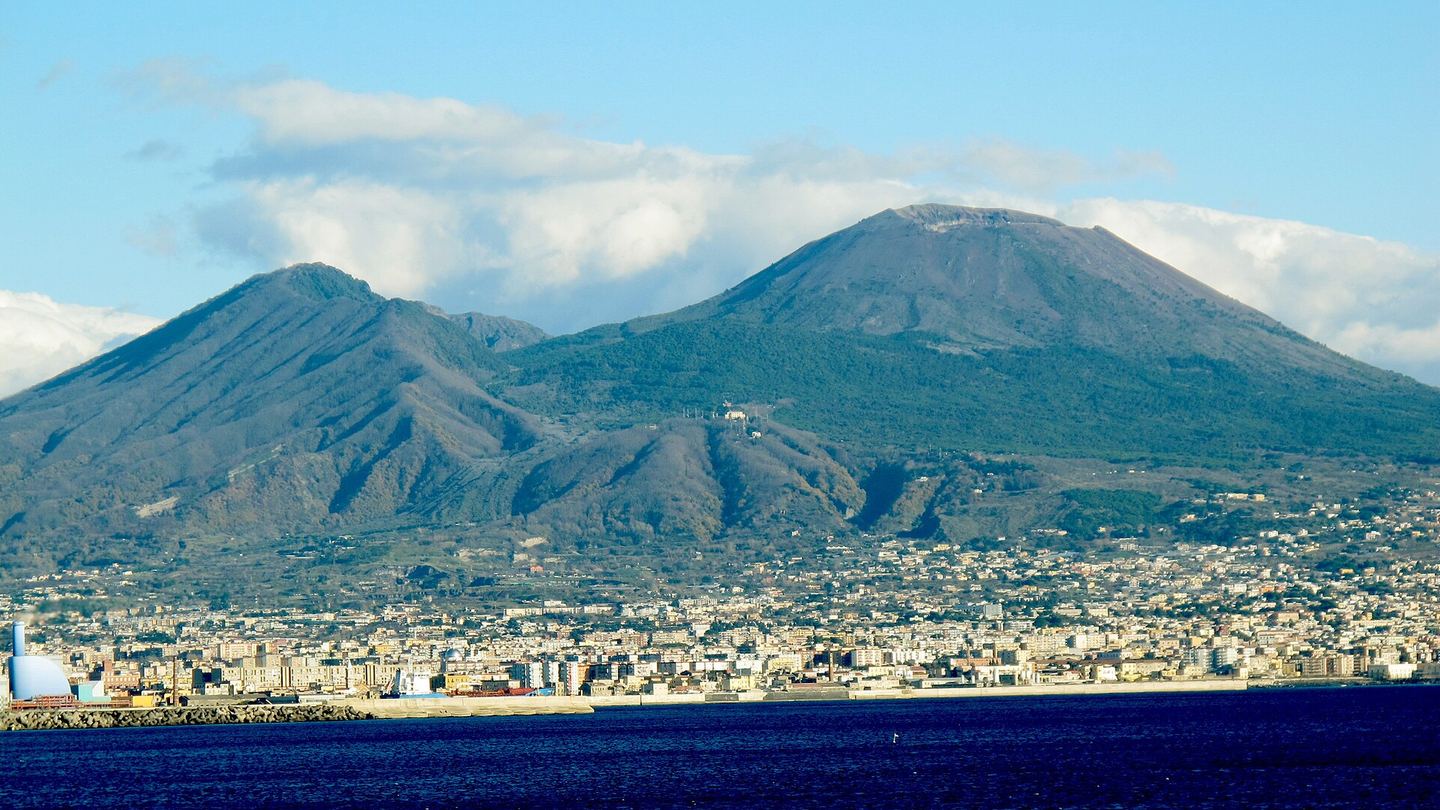
Vesuvius and the surrounding coastline, photographed in 2012; not a view inside the crater. Pietro Scerrato, CC BY 3.0. Cropped for layout.

Books being read without being opened
The library of the Villa dei Papiri at Herculaneum was carbonised in the eruption. Its fragile scrolls remained unreadable for more than two centuries. Recent teams have used X-ray scans, computer vision and machine learning to reveal text inside still-rolled scrolls without ordinary physical unrolling. In 2026, the Vesuvius Challenge reported that one Herculaneum scroll had been virtually unwrapped and read end to end; the work on the others is still ongoing.
SourcesNational Endowment for the Humanities · University of Oxford · Vesuvius Challenge3
- National Endowment for the Humanities · accessed 14 September 2026
Evidence note. Supports the carbonisation, fragility and digital unwrapping of the Herculaneum scrolls; it describes the library's scrolls as unreadable for more than two centuries.
- University of Oxford · 7 February 2025
Evidence note. Documents the July 2024 scan of PHerc. 172 and the subsequent use of AI to assemble and clarify its virtually unrolled text.
- Vesuvius Challenge · accessed 14 September 2026
Evidence note. The project's current results page identifies PHerc. 1667 as the first Herculaneum scroll virtually unwrapped and read end to end in 2026, while listing further sealed scrolls as an open challenge.
The only vitrified human brain on record
A 2025 study in Scientific Reports describes a unique case of vitrified human brain tissue from a victim at Herculaneum. Its calorimetric analysis found that the brain transformed into glass at well above 510°C. The authors infer a brief, dilute and much hotter pyroclastic flow: fast heating followed by very fast cooling, before the heavier deposits buried the site.
SourceScientific Reports1
- Scientific Reports · 27 February 2025
Evidence note. Open-access primary study. It identifies the brain tissue as a unique case and describes the temperature as well above 510°C; the event sequence is the authors' reconstruction from the material evidence.
The date is still contested
The familiar 24 August date comes from surviving copies of Pliny the Younger's letter, not from its lost original; the copies give different months. In 2018, excavations in Pompeii's Regio V uncovered a charcoal inscription dated 17 October. The Archaeological Park says it supports an October hypothesis, while INGV's multidisciplinary research places the eruption in autumn. That is stronger than calling 24 August settled, but it is not a licence to claim a single exact day from the inscription alone.
SourcesArchaeological Park of Pompeii · Istituto Nazionale di Geofisica e Vulcanologia2
- Archaeological Park of Pompeii · 2018
Evidence note. The Park's excavation dossier says the 17 October charcoal inscription supports an October, rather than August, hypothesis and notes that surviving transcriptions of Pliny's letter give different months.
- Istituto Nazionale di Geofisica e Vulcanologia · 2022
Evidence note. INGV's account of its multidisciplinary study says the eruption would have occurred in autumn and explains that the inscription establishes it after 17 October.
A private spa for thirty guests
In Pompeii's Regio IX, archaeologists excavated one of the largest known private bath complexes in a Pompeian house: hot, warm and cold rooms, plus a changing room whose benches could accommodate up to thirty people. The cold room is a ten-by-ten-metre peristyle with a large pool. It connects directly to a banqueting room, making the house a place for display as well as bathing.
SourceArchaeological Park of Pompeii1
- Archaeological Park of Pompeii · 17 January 2025
Evidence note. Primary excavation announcement. It identifies the rooms, the benches for up to thirty people, the ten-by-ten-metre cold-room peristyle and the connection to the banqueting hall.
A second Villa of the Mysteries
In February 2025, archaeologists announced a near life-size Dionysian frieze covering three walls of a banqueting room in Regio IX: bacchantes, satyrs and huntresses. The Ministry of Culture dates it to 40–30 BC, so the painting was already about a century old when Vesuvius erupted. The Regio IX excavation covers about 3,200 square metres and has identified more than fifty new rooms across the area.
SourceMinistry of Culture1
- Ministry of Culture · 26 February 2025
Evidence note. Primary announcement. It dates the frieze to 40–30 BC and reports the approximately 3,200-square-metre Regio IX excavation area and more than fifty new rooms; the precise reading of the figures remains archaeological interpretation.
Two men, hours apart
Near Porta Stabia, two men were found metres apart after dying in different phases of the eruption. The older man died beneath falling lapilli while apparently trying to shield his head with a terracotta mortar. He carried a ceramic lamp, a small iron ring on his left little finger and ten bronze coins. The younger man was probably caught later by a pyroclastic flow while trying to reach the coast. The sequence comes from the archaeological context, not a witness account.
SourceMinistry of Culture1
- Ministry of Culture · 27 April 2026
Evidence note. Primary announcement. It reports two men who died at different moments, the older man's mortar, lamp, iron ring and ten coins, and the archaeological interpretation of the younger man's death in a pyroclastic flow.
Two equids outside the stable
At the Casti Amanti bakery, excavators found two large herbivores outside the nearby stable, in a room beside the oven. The Archaeological Park identifies them cautiously as equids, not yet as a confirmed horse or donkey. Laboratory work is still underway on their role in the production complex and the conditions of their deaths. Their location raises questions about movement during the eruption, but it does not reveal a single animal's escape route.
SourceArchaeological Park of Pompeii1
- Archaeological Park of Pompeii · 5 June 2026
Evidence note. Primary excavation report. It describes two large herbivores outside the nearby stable and treats taxonomic identification and the conditions of the animals at the eruption as work still in progress.
Pompeii and Herculaneum are not finished sites. They are active ones, and the news from them is better than the guidebooks.