Things that never stopped
A quarry working since 1387, a forest owned collectively since 1111, a mountain road cut by hand in nine months
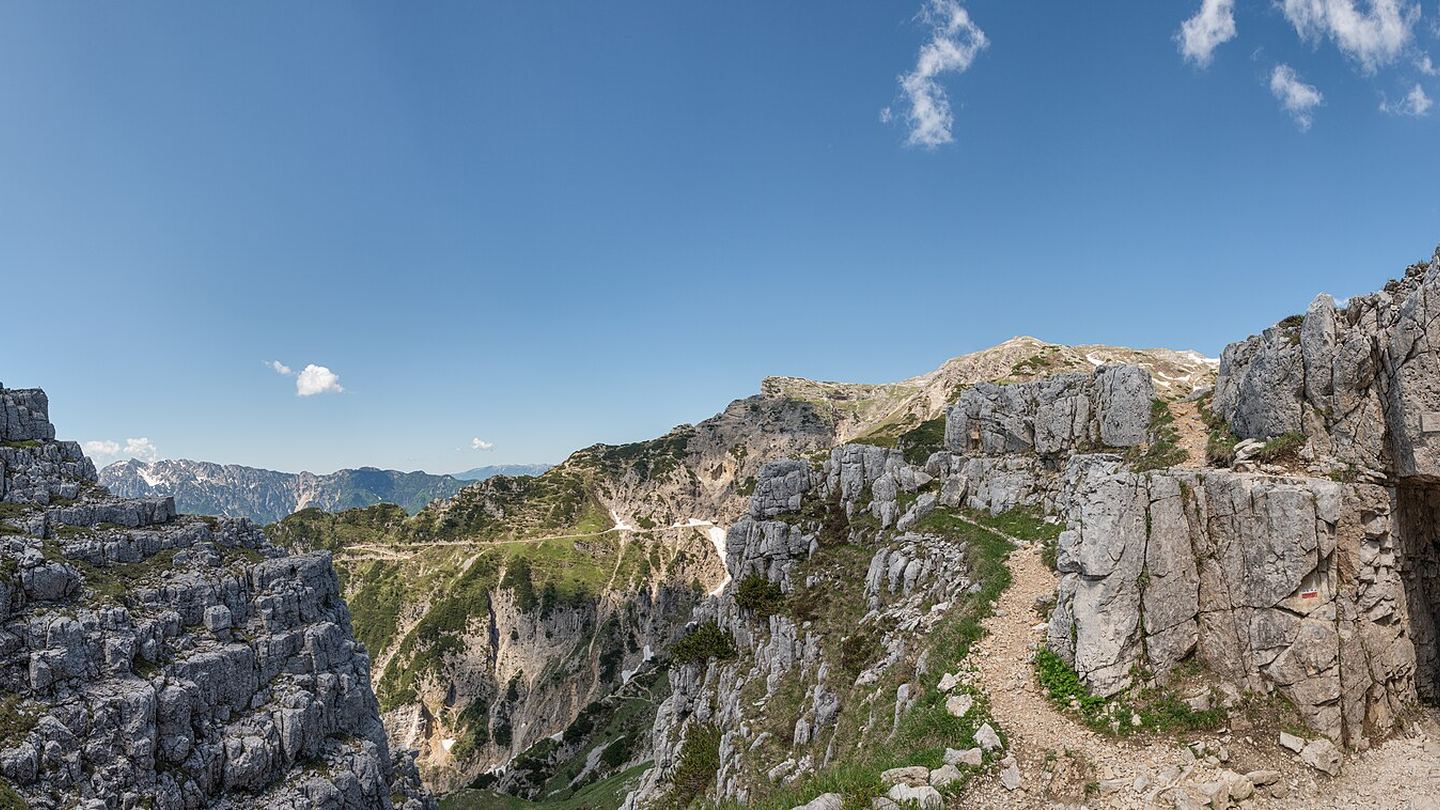
Galleria 52 on the hand-cut road across Monte Pasubio. Giorgio Galeotti, CC BY 4.0. Cropped for layout.

The quarry that still maintains the Duomo
On 24 October 1387, Gian Galeazzo Visconti gave the Candoglia quarry to the Veneranda Fabbrica del Duomo di Milano and granted free transport of its marble to Milan by water. The Fabbrica says it was founded that year for the Cathedral's construction and continues to conserve and restore it. Candoglia marble is still extracted and processed for the Cathedral's architectural and decorative elements. The continuity is documented by the institution that runs the quarry and the conservation work; it does not mean that every stone or every workshop practice has remained unchanged for more than six centuries.
SourcesVeneranda Fabbrica del Duomo di Milano2
- Veneranda Fabbrica del Duomo di Milano · current institutional profile
Evidence note. The Fabbrica's history of the 24 October 1387 grant, water transport and its current maintenance of the quarry.
- Veneranda Fabbrica del Duomo di Milano · current institutional profile
Evidence note. The Fabbrica describes the continuing chain from Candoglia extraction through the Marble Yard to replacement architectural and decorative elements on the Duomo.
A valley whose woods are still collectively managed
The Magnifica Comunità di Fiemme traces its first official recognition to the Patti Gebardini of 14 July 1111. Its current statute says that the collective patrimony — principally woodland and pasture — belongs to the Comunità dei Vicini, while the Magnifica Comunità is the historic institution that legally represents it and administers that property. It is not a municipality or a commercial cooperative. The institution's own historical archive describes major changes in the early nineteenth century, when it lost political and judicial authority and took on a predominantly economic role. The durable fact is the collective property and its present administration, not an unchanged form of government across a millennium.
SourcesMagnifica Comunità di Fiemme2
- Magnifica Comunità di Fiemme · approved 2019
Evidence note. Articles 1–4 trace the institution to the 1111 pacts, define the collective patrimony of the Vicini and the representative, administrative role of the Magnifica Comunità.
- Magnifica Comunità di Fiemme · current archive record
Evidence note. The archive describes the early nineteenth-century rupture and the later economic role managing the forest and real-estate patrimony.
Fifty-two numbered tunnels through Pasubio
The Strada delle 52 Gallerie is a First World War military mule track on Monte Pasubio. Veneto's official Great War itinerary describes it as built in 1917 in a few months to create an ascent route sheltered from Austrian artillery. CAI Veneto gives the route a length of 6,555 metres, including 2,335 metres carved into rock, and confirms that its 52 tunnels are numbered; the nineteenth is the longest and follows a helical path with four internal bends. That history does not certify a walk on a particular day. The Municipality of Valli del Pasubio publishes temporary access bans for maintenance, so a visitor must check the current notice, conditions and appropriate mountain equipment before setting out.
SourcesVeneto Region tourism · CAI Veneto · Municipality of Valli del Pasubio3
- Veneto Region tourism · Great War itinerary
Evidence note. Regional itinerary says the road was built in 1917 in a few months to create a route protected from Austrian artillery.
- CAI Veneto · route profile
Evidence note. CAI Veneto describes the 6,555-metre route, 2,335 metres in tunnels, 52 numbered tunnels and the nineteenth tunnel's helical course.
- Municipality of Valli del Pasubio · current notices
Evidence note. The Municipality has issued maintenance-related pedestrian closures; use the latest notice rather than assuming access from a historical description.
A saint's procession with live snakes
Cocullo's annual Festa di San Domenico Abate includes the Rito dei Serpari, in which the saint's statue is carried in procession covered with live snakes. The Municipality published the 2026 civic and religious programme for 30 April and 1 May. The National Park of Abruzzo, Lazio and Molise records that people capture snakes for the event under a legal derogation, with temporary custody regulated and the animals released again at their capture sites. That confirms the present practice and its wildlife controls; it does not establish one certain ancient origin for the rite or make an earlier year's programme a guarantee for a future date.
SourcesMunicipality of Cocullo · National Park of Abruzzo, Lazio and Molise2
- Municipality of Cocullo · April 8, 2026
Evidence note. Official municipal programme for the 30 April and 1 May 2026 religious and civic celebrations.
- National Park of Abruzzo, Lazio and Molise · scientific atlas
Evidence note. The Park explains the derogation governing temporary capture and custody of snakes for the rite and their subsequent release at capture sites.
Hundreds of tonnes of oranges, but not one fixed number
Ivrea's Battle of the Oranges is the central spectacle of the Historic Carnival. The Foundation says participants can join one of nine teams on foot or a throwing cart, while its history locates the orange-throwing custom in the mid-nineteenth century. Its current circular-economy report gives a useful dated measure rather than an invented permanent total: after the 2025 event, about 731,000 kilograms of oranges were collected for recovery and recycling, up from about 715,000 kilograms in 2024. Those figures describe those editions' collected material, not the number of oranges thrown in every year or the scale of a future Carnival. The official programme and safety rules must be checked for the edition a visitor intends to attend.
SourcesFondazione dello Storico Carnevale di Ivrea2
- Fondazione dello Storico Carnevale di Ivrea · current institutional description
Evidence note. The Foundation describes the battle, its nine on-foot teams, carts and the mid-nineteenth-century origins of orange throwing.
- Fondazione dello Storico Carnevale di Ivrea · 2026 report
Evidence note. The Foundation reports about 731,000 kg collected in 2025 and about 715,000 kg in 2024, and describes recovery and recycling.
A Pollino pine dated to Charlemagne's era
In 2018 researchers reported that a living Heldreich's pine in Italy's Pollino National Park, named Italus, was 1,229 years old in 2017. Their method combined tree-ring cross-dating with radiocarbon work on exposed roots to refine the date back to 789 CE. The authors described Italus as Europe's oldest scientifically dated living tree at that time. That is a claim about the dated specimen and the study's method — not proof that every old-looking pine in the park has the same age, nor a current census of Europe's oldest trees.
SourcesEcology / research record at PubMed · MethodsX / research record at PubMed2
- Ecology / research record at PubMed · 2018
Evidence note. Peer-reviewed Ecology record identifying Italus as a strip-bark Heldreich's pine in the Pollino massif.
- MethodsX / research record at PubMed · 2018
Evidence note. Method paper: the revised estimate places Italus at 1,229 years in 2017 and 789 CE, using tree-ring and radiocarbon procedures.
A laboratory beneath a motorway tunnel
The Gran Sasso National Laboratories operate three underground experimental halls, each about 100 metres long, 20 metres wide and 18 metres high, plus service tunnels: about 180,000 cubic metres in all. They sit beside the 10-kilometre motorway tunnel through the mountain, beneath about 1,400 metres of rock. LNGS says that cover reduces the cosmic-ray flux by about a million, creating a low-background environment for rare-event physics. Its current overview reports about 1,300 scientists from 30 countries taking part in the experimental activities. These figures describe the laboratory, not unrestricted visitor access; visits and access follow the laboratory's own rules.
SourcesGran Sasso National Laboratories / INFN · Italian National Institute for Nuclear Physics2
- Gran Sasso National Laboratories / INFN · current institutional overview
Evidence note. Official LNGS overview of the three halls, volume, motorway-tunnel location, rock cover, cosmic-ray reduction, and current scientist and country counts.
- Italian National Institute for Nuclear Physics · current institutional profile
Evidence note. INFN profile of its national laboratories and the research role of LNGS.
The common thread is institutional rather than sentimental. These things survive because somebody wrote them down and nobody repealed them.