The rules Italians live with
Dress codes, entry fees, tourist taxes and a bridge waiting on an accounting court
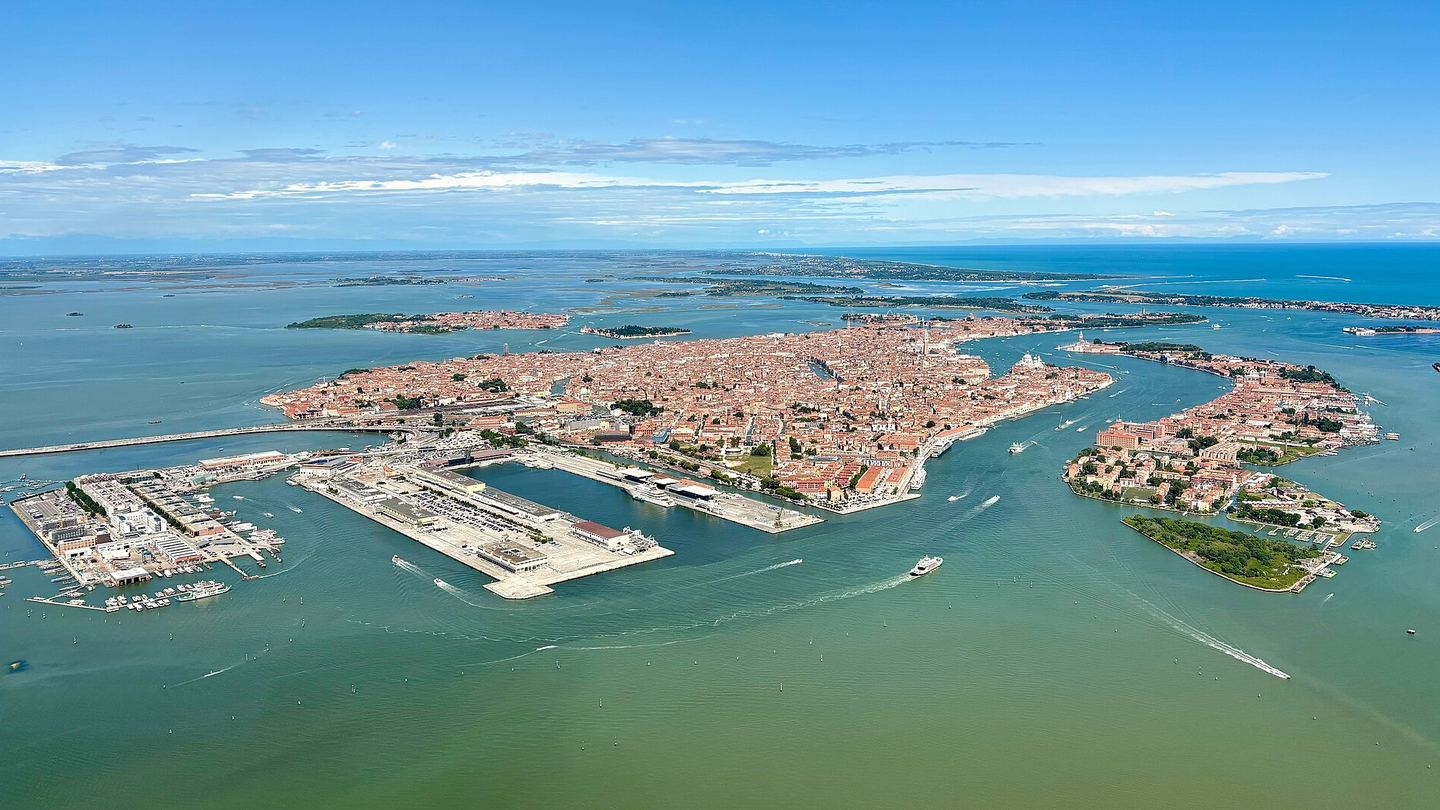
Venice and its lagoon from the air. Kallerna, CC BY-SA 4.0. Cropped for layout.

Venice charged more for late booking
In its experimental 2026 scheme, Venice applied an Access Fee on 60 selected days between 3 April and 26 July, from 8:30 a.m. to 4 p.m. It applied to the ancient city, not the smaller lagoon islands, and exclusions and exemptions still mattered. People required to pay paid €5 by the fourth-last day before their visit, or €10 in the final three days. The City said the two-tier system was intended to encourage earlier planning and help manage day trips. The 2026 experiment ended on 26 July; a future year requires a new municipal measure, so a visitor must check the official page for the date they intend to visit.
SourcesCity of Venice2
- City of Venice · 2026 scheme
Evidence note. Official rules for the 2026 dates, hours, area, exemptions and early-booking price tiers.
- City of Venice · July 2026
Evidence note. The City confirms that the 2026 experimental period ended on 26 July after 60 non-consecutive days.
Cortina's summer decorum order
Cortina d'Ampezzo's Mayor issued Order no. 144 on 13 August 2026, in force through 15 October 2026. Within the listed urban areas, it prohibits lying on steps of monuments and places of worship, camping or eating, drinking, washing or sleeping on public ground in a manifestly indecent way or so as to cause obstruction or disturbance, and remaining in unsuitable clothing. The administrative penalty is €25 to €500, with a €50 reduced-payment option where applicable. It is a time-limited local order, so a visitor outside its window must check the current municipal rules rather than assume it remains in force.
SourceMunicipality of Cortina d'Ampezzo1
- Municipality of Cortina d'Ampezzo · August 13, 2026
Evidence note. Official notice and attached order: scope, prohibited conduct, 15 October 2026 end date and penalty range.
The tourist-tax map keeps expanding
JFC, a tourism-sector observatory rather than the Italian tax authority, reported that 1,411 municipalities were applying a tourist tax in 2026 — 24 more than in 2025 — and projected national revenue above €1.2 billion. Its 2026 city figures, including €288 million for Rome, €110 million for Milan and €82.7 million for Florence, are forecasts, not municipal accounts. There is no single Italian rate: each municipality issues its own regulation and tariff resolution. The Finance Department publishes the 2026 archive of those local acts, so the amount, exemptions and season for a particular stay must be checked against the municipality or accommodation before booking.
SourcesFederturismo Confindustria, reporting JFC · Italian Ministry of Economy and Finance, Department of Finance2
- Federturismo Confindustria, reporting JFC · April 20, 2026
Evidence note. A sector report, not an official tax return: it labels the €1.2 billion and city figures as 2026 projections.
- Italian Ministry of Economy and Finance, Department of Finance · 2026 archive
Evidence note. Official archive of the municipal regulations and tariff resolutions; the applicable amount and exemptions must be checked for the particular municipality and stay.
A one-euro house is not a one-euro project
Sant'Elia a Pianisi runs a municipal ‘Case a 1 euro’ service for private individuals and legal entities. The €1 figure is a symbolic sale price, not a complete cost: the Municipality says the buyer pays the agreed purchase value to the seller and bears the expenses connected with transferring ownership. Its current project page says the list of available properties is temporarily hidden while the participating buildings and requirements are being checked and updated. A person interested in a particular house must therefore ask the Municipality for the current listing and documents, then obtain independent legal, technical and renovation-cost advice before committing. The municipal page does not make a fixed renovation budget or a guarantee amount a universal current rule.
SourcesMunicipality of Sant'Elia a Pianisi2
- Municipality of Sant'Elia a Pianisi · updated January 23, 2025
Evidence note. Official service page: who may apply, transfer costs, application process and current municipal contact details.
- Municipality of Sant'Elia a Pianisi · updated November 28, 2025
Evidence note. The Municipality states that its available-property list is temporarily not visible while it updates participating buildings, participation details and requirements.
Approval is not a crossing
Italy's CIPESS approved the updated final project for a fixed link across the Strait of Messina on 6 August 2025. The Ministry said that approval covered the updated project, programme of works and services, environmental-review conclusions, financial plan and a stated funding requirement of about €13.5 billion. In July 2026, however, the Ministry said that its offices and the Environment Ministry were still preparing environmental information requested by the European Commission; later that month it described work continuing at the board of Stretto di Messina. Those administrative steps are not a timetable for a completed crossing. Anyone following the project should check the newest official project, environmental and procurement notices rather than repeat an earlier headline as its present status.
SourcesItalian Ministry of Infrastructure and Transport3
- Italian Ministry of Infrastructure and Transport · August 6, 2025
Evidence note. Official announcement of the CIPESS approval and the components the Ministry says were included, including the stated €13.5 billion funding requirement.
- Italian Ministry of Infrastructure and Transport · July 13, 2026
Evidence note. The Ministry says it and MASE were preparing additional environmental information requested by the European Commission.
- Italian Ministry of Infrastructure and Transport · July 29, 2026
Evidence note. Official note that the Minister attended the company board meeting and referred to work continuing on the project.
UNESCO listed a living practice, not a recipe book
UNESCO inscribed ‘Italian cooking, between sustainability and biocultural diversity’ on its Representative List of the Intangible Cultural Heritage of Humanity in 2025. At the Committee's New Delhi session on 10 December, Italy's Culture Ministry described the element as a living cultural practice: seasonal ingredients, shared meals, local traditions and knowledge passed between generations. The inscription does not create a universal rule for what a dish must contain, certify every restaurant, or turn ‘Italian food’ into one protected recipe. UNESCO's own file identifies the element and the Representative List; the Ministry's announcement gives the date and setting of the decision.
SourcesUNESCO Intangible Cultural Heritage · Italian Ministry of Culture, UNESCO Office2
- UNESCO Intangible Cultural Heritage · inscribed 2025
Evidence note. UNESCO's official element file: Italy, 2025 inscription, Representative List and decision record.
- Italian Ministry of Culture, UNESCO Office · December 10, 2025
Evidence note. Official Italian announcement of the Committee decision in New Delhi and its description of the cultural practice.
Read the local ordinance before you read the guidebook. In Italy the ordinance changes faster and matters more.